The regulator sits on top
Every gambling business serving customers in Great Britain answers to the Gambling Commission, the statutory regulator created by the Gambling Act 2005. Since the Gambling (Licensing and Advertising) Act 2014, the rule has been point of consumption: it doesn't matter where a company's servers or head office sit — if it takes bets from people in Britain, it needs a British licence.
A licence isn't a certificate on a wall. It comes with the Licence Conditions and Codes of Practice, a running rulebook covering everything from how customer funds must be described to how bonuses may be advertised. Breaches get published, and the Commission's enforcement pages make instructive reading — fines for weak money-laundering checks and for failing to protect struggling customers appear there regularly, including against household names.
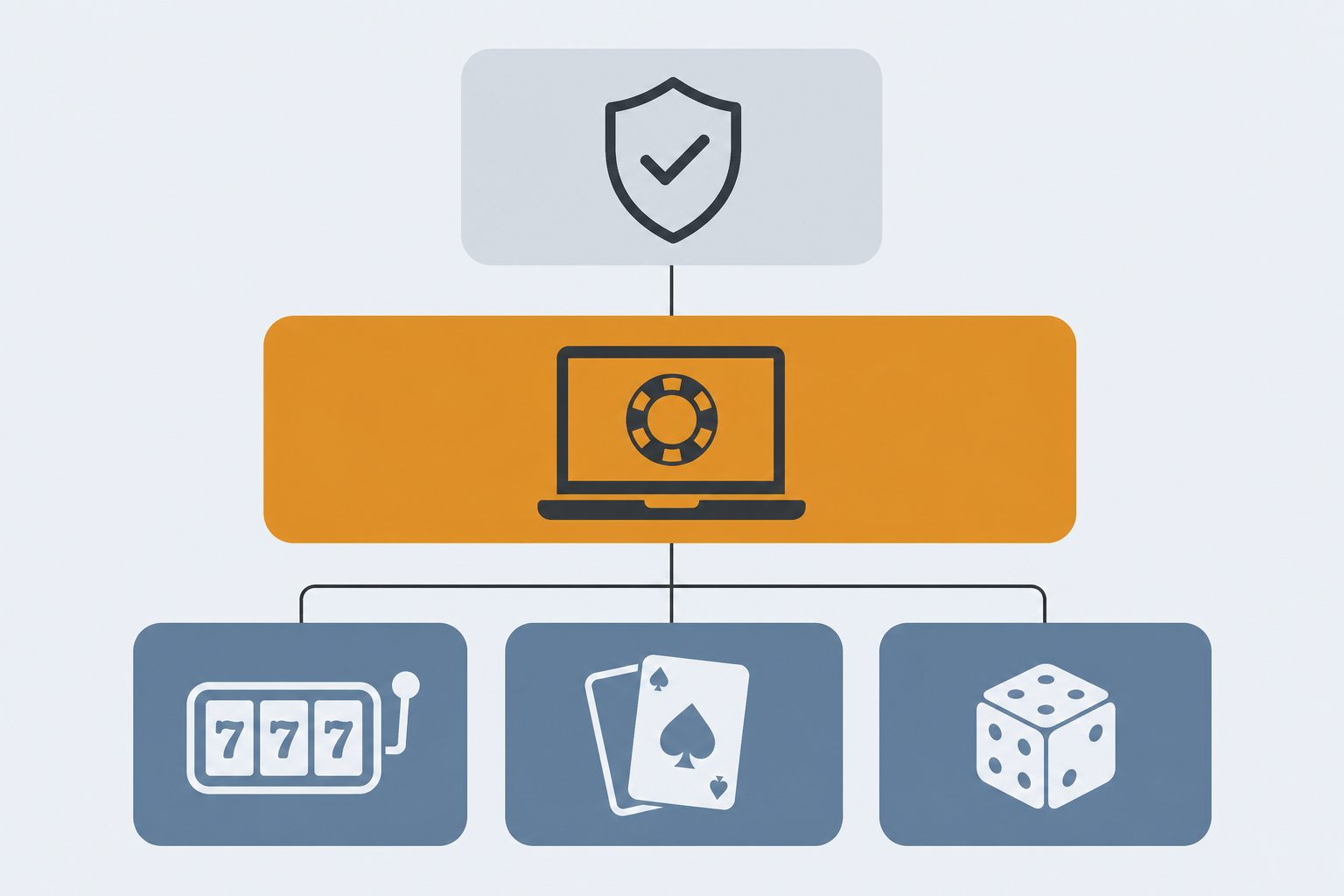
Operators run the shop, not the games
The casino brands you recognise — the five we review included — are essentially retailers. They hold the licence, run the website and the app, manage accounts and handle marketing. What they mostly don't do is build the games. A modern casino lobby is stocked the way a supermarket shelf is: through supply deals with specialist studios and aggregators.
That's why the same slot appears at Sky Vegas, LeoVegas and BetMGM in identical form. A title by NetEnt or Pragmatic Play is one product distributed to hundreds of licensed shops. The casino chooses what to stock and how to present it; the studio controls how the game behaves. It's also why "1,000+ games" claims deserve a shrug — much of any two casinos' catalogues overlaps, and the interesting question is what a site stocks that others don't.
Ownership is more concentrated than the brand names suggest. Flutter Entertainment owns Sky Vegas alongside Paddy Power and Betfair. MGM Resorts bought LeoVegas in 2022 and later launched BetMGM in the UK on the same group's technology. Two apparently competing sites can be cousins under the bonnet — worth knowing when a "different" casino turns out to have a familiar lobby.
The studios and the live-dealer floors
Slot studios range from giants like Playtech, Light & Wonder and Pragmatic Play down to boutiques such as Big Time Gaming, whose Megaways mechanic was licensed out across the industry. Live casino is its own discipline: real dealers at physical tables, streamed from purpose-built studios, with Evolution supplying the bulk of the UK market's live tables. When a casino advertises "exclusive" live tables, it usually means a dedicated area inside a supplier's studio, branded and staffed for that one operator.
Suppliers aren't outside the regulatory net, either. Companies providing gambling software to the British market need their own Commission licence, so a game's journey from studio to your screen passes through two licensed businesses, not one.
Where sites like this one fit
Comparison and review sites — Table Markings among them — are the industry's shop window layer. Operators pay affiliates a commission for introduced customers, which is the business model behind almost every casino comparison page on the internet, whether or not it says so plainly. UK advertising rules treat affiliates as advertisers: the Advertising Standards Authority's code applies, promotional content must be identifiable as such, and misleading bonus claims are actionable. That's why offer mentions here carry the "Ad · 18+ · T&Cs apply" tag and why we keep the wording factual.
The honest test of any affiliate site is whether the commission shapes the verdicts. Ours don't — the scoring criteria are published on the homepage methodology section, and our funding is spelled out in the affiliate disclosure.
Why every offer page looks the same
If you've noticed that all casino promotions carry near-identical footnotes, that's regulation working as intended. Operators must present significant terms — wagering requirements, expiry, game restrictions — alongside any advertised bonus, and the 18+ marker and safer-gambling messaging are compulsory in ads. The uniformity is a floor, not a ceiling: some operators write their full terms clearly on one page, others bury the practical details in clause 14 of a scrolling document. Sorting one group from the other is a large part of what we do on the promotions guide.